| |
 |
Homepage |
|
| |
 |
About Us |
| |
 |
Contact |
| |
 |
CBT & ADHD ASD OCD |
| |

|
Anxiety |
| |
 |
Depression |
| |
 |
Personal Injury
& Road Traffic Incidents |
| |
 |
Pain Management |
| |
 |
CBT Coaching |
| |
 |
Supervision of CBT & EMDR |
| |

|
Seeking an EMDR Therapist? |
| |
 |
Free
Resources |
| |
 |
Links |
| |
 |
Privacy Policy |
|
 |
Terms & Conditions |
|
|
Depression and Cognitive Behavioural Therapy (CBT) |
|
Are you experiencing sadness, low mood,
feelings of emptiness, or emotional numbness rather than
occasional feelings of being "down"? Do daily
responsibilities feel physically overwhelming, accompanied
by persistent fatigue? Have you lost interest in hobbies,
activities, social relationships? Do you encounter recurrent
feelings of worthlessness or hopelessness?
How can BTA help you with your depression
Our therapists provide a safe, confidential, and welcoming
space where you will be supported to explore and look at
unhelpful thought patterns, manage your emotions, and
discover coping strategies that really work for you. A CBT
therapist will work with you tackle difficult thinking and
behaviours, manage mood and help you to see things from
fresh perspectives. CBT encourages greater self-acceptance
and understanding. It offers practical tools focusing on how
your thoughts, feelings, and actions are linked. If you
experience depression or low mood CBT can help you make
positive changes and support your overall wellbeing.
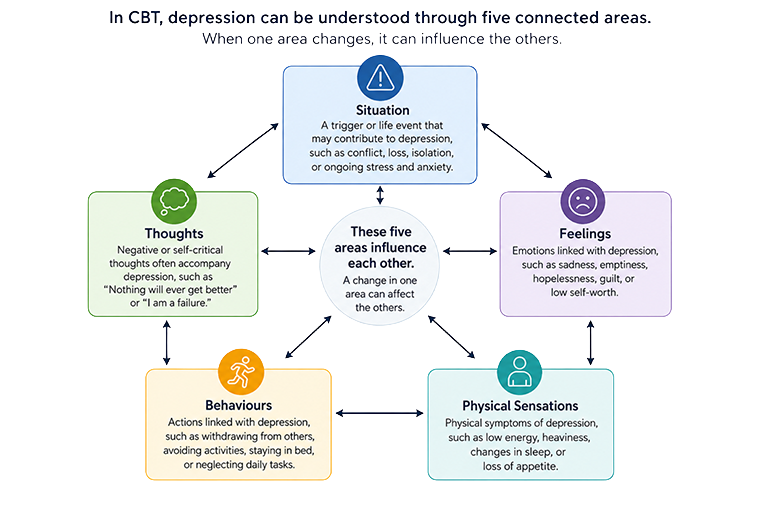
How CBT Understands Depression
In depression, people often get caught in cycles such as
illustrated below:
|
|
|
|
CBT targets this cycle directly. Rather than
focusing solely on why you feel the way you do, it
emphasises what is happening right now and what you can do
about it.
What makes CBT Effective?
CBT is one of the most well researched
treatments for depression and is recommended by
organisations such as the National Institute for Health and
Care Excellence (NICE). It has strong evidence for:
• Reducing depressive symptoms
• Preventing relapse
• Teaching skills that remain useful long after therapy ends
Individuals are encouraged to ask questions
like, "What is the evidence for and against this
thought?" or "What is the worst that can happen, and could I
realistically handle it?"
This practice helps reframe pessimistic perspectives
into rational, balanced ones. By identifying and changing
patterns such as self-critical thinking and avoidance, CBT
helps break the cycle that maintains depression and supports
healthier coping strategies in everyday life. It encourages
individuals to build practical skills that improve
resilience, emotional balance, and overall quality of life.
A personalised approach at BTA
Whilst CBT works well for many people and we have CBT
specialists in our team, some individuals prefer other
approaches, such as EMDR therapy (see EMDR-Birmingham.co.uk)
or a combination of therapy and medication. You may find
that you would like CBT but applied in an integrative way.
We have integrative therapists who combine CBT, Mindfulness,
Dialectical Behaviour Therapy (DBT), trauma-focused
therapies, Psychodynamic therapy and other highly effective
therapeutic models to support depression.
CBT-Birmingham is a private treatment service which provides
access to CBT therapists working in clinics in the Midlands
and in a selected location in London. We also work online.
We take referrals from individuals, organisations,
solicitors, GPs, and case managers. |
| Contact |
|
CBT-Birmingham
+44 7828 754390
info@cbt-birmingham.co.uk
Mo, Tu, We, Th, Fr 9:00 am – 5:00 pm
Outside of our opening hours please leave a message and we
will get back to you within 24 hours. You can contact us via
email or WhatsApp. If we are not available we will respond
to you within 24 hours.

Please be aware that we
do not offer a crisis or out of hours service.
If your need is urgent, please
use your GP, NHS111 or your local A&E service.
If you need to speak to someone, contact the Samaritans on a
free 24-hour line from any phone on 116 123. |
|

